
A successful construction project depends on many interconnected elements. The visible parts of a building may receive the most attention, but the systems hidden behind walls, beneath floors, and underground often determine how well a property performs over the long term.
Water supply, drainage, wastewater management, utility networks, and flooring systems all need to be planned carefully. Selecting the right materials for these applications can influence installation efficiency, maintenance requirements, durability, safety, and overall project costs.
For contractors, developers, architects, and property owners, material selection should therefore be approached as part of the overall project strategy. Rather than choosing products based only on price, it is important to understand the conditions in which the materials will be installed and the demands they will face throughout their service life.
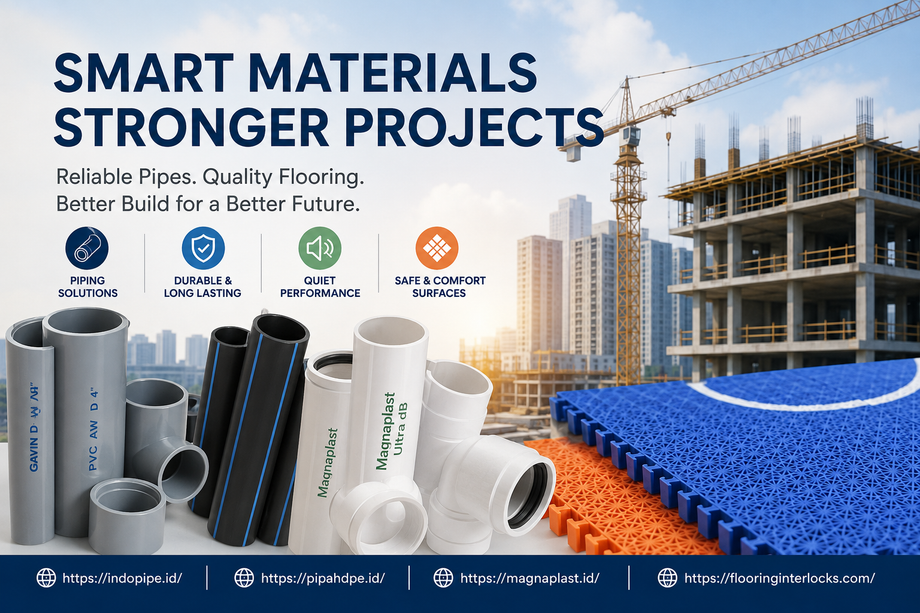
Different materials offer different characteristics. PVC pipes can provide a practical option for many building plumbing systems, while HDPE is frequently considered for water distribution and infrastructure applications. Acoustic drainage systems address a different concern by focusing on noise reduction. In sports facilities, specialized flooring can help create a surface suitable for repeated physical activity.
Understanding these differences makes it easier to develop reliable building systems.

Start With the Purpose of the System
Before selecting a construction material, the first question should always be: what is the material expected to do?
A pipe transporting clean water has different requirements from a pipe carrying wastewater. Likewise, a drainage pipe installed in a hotel may require different considerations from one used in a small residential building.
The operating environment can influence material selection as well. Temperature, pressure, exposure to chemicals, soil conditions, installation depth, and expected usage can all affect the performance of a product.
A useful material-selection process should consider several factors, including:
- Intended application
- Operating pressure
- Temperature range
- Chemical exposure
- Installation environment
- Product dimensions
- Connection method
- Maintenance requirements
- Expected service life
- Availability of replacement components
This approach can help prevent problems caused by selecting a product that appears suitable but does not actually match the project’s technical requirements.
PVC as a Practical Plumbing Material
PVC, or Polyvinyl Chloride, has become a common material in residential, commercial, and utility applications. Its relatively lightweight characteristics make it easier to handle during transportation and installation compared with many traditional materials.
PVC is commonly used for water distribution, sanitation, drainage, and other utility systems. Different classifications can be selected depending on the pressure and application involved.
For example, a pressurized water installation may require a thicker pipe specification than a drainage application. Diameter is also important because it influences the capacity of the system and should be determined according to the required water flow.
Another consideration is the connection system. Pipes and fittings need to be compatible, while installers should follow the recommended procedures to create reliable joints.
A range of PVC and other piping products can be explored at https://indopipe.id/. The company provides various piping categories, including PVC, HDPE, PPR, corrugated, and acoustic systems. Its product range includes PVC products under brands such as Gavin and Altalon.
For project managers, the availability of multiple pipe categories can make procurement more flexible, especially when a project involves different plumbing and utility requirements.
Understanding Pressure and Pipe Classification
One of the most important technical considerations when selecting a pipe is pressure.
Water systems may operate under different pressure conditions depending on the building height, pumping system, distribution design, and intended application.
Using a pipe with an unsuitable pressure classification can create unnecessary risks. The pipe wall thickness, material properties, and connection system should all correspond to the design requirements.
For PVC systems, classifications such as AW, D, and C are commonly associated with different applications and pressure capabilities. The appropriate classification should be determined from the engineering requirements rather than simply based on diameter or price.
This is particularly important when purchasing large quantities for a construction project. A small difference in specification can become significant when multiplied across hundreds or thousands of pipe sections.
Contractors should therefore verify the technical specification before placing an order.
Why HDPE Is Important for Infrastructure
Infrastructure projects often require materials that can withstand challenging installation conditions. Underground water networks, irrigation systems, industrial pipelines, and large-scale distribution systems may require flexibility in addition to strength.
HDPE, or High-Density Polyethylene, is commonly considered for these applications because of its flexibility and resistance to corrosion.
Compared with metal piping, HDPE does not experience conventional rust-related corrosion. Its flexibility can also provide advantages in certain installations where the pipeline needs to accommodate site conditions.
HDPE products are available in different diameters, SDR classifications, and pressure ratings. Selecting the correct combination is important because the requirements for a high-pressure water network may be different from those of an irrigation or drainage application.
Information about HDPE products, including LESSO solutions, is available at https://pipahdpe.id/. The product information covers applications such as clean water distribution, infrastructure, irrigation, and industrial systems.
The Importance of Proper HDPE Installation
Material quality alone does not determine the performance of an HDPE pipeline. Installation procedures are equally important.
Depending on the system, HDPE pipes can be joined using methods such as butt fusion or electrofusion. These techniques require appropriate equipment and proper preparation of the pipe surfaces.
Alignment is another important consideration. Pipes need to be positioned correctly before joining to reduce stress on the completed system.
Testing should also form part of the installation process. Depending on the application and project specifications, pressure testing can help identify potential problems before the system enters regular operation.
This illustrates a broader principle in construction: the quality of installation can be just as important as the quality of the material itself.
Managing Noise in Multi-Story Buildings
Building performance is not limited to structural strength or water delivery. Occupant comfort is also becoming an important consideration in residential and commercial properties.
Plumbing systems can generate noise when water flows through drainage pipes. This may include the sound of wastewater movement, vibration, and impact inside the piping system.
In a detached house, these sounds may have limited impact. In an apartment, hotel, hospital, or office building, however, plumbing noise can become more noticeable because multiple occupied areas may be positioned close to drainage systems.
Acoustic drainage systems are designed to address this particular challenge.
Magnaplast’s acoustic pipe system is positioned for applications where low-noise drainage is important. Its information describes a multilayer construction designed to reduce plumbing noise, with applications including apartments, hotels, hospitals, and residential buildings.
Additional information about the system can be found at https://magnaplast.id/.
Acoustic Design Requires More Than a Special Pipe
It is important to remember that a low-noise pipe does not work in isolation.
The final acoustic performance of a drainage system can be affected by pipe supports, brackets, wall structures, connections, water velocity, and the way vibration is transmitted into the building.
For example, if a pipe is rigidly connected to a structural element, vibration may be transferred through the building even when an acoustic pipe is being used.
For this reason, acoustic plumbing should be considered during the design stage rather than added as an afterthought.
Architects, engineers, and contractors can coordinate the location of drainage shafts, pipe supports, wall construction, and service areas to improve overall acoustic performance.
This approach is particularly valuable in buildings where occupant comfort is a major design consideration.
Choosing Materials Based on Lifecycle Value
Construction budgets naturally focus on initial costs, but lifecycle costs deserve equal attention.
A product that costs less to purchase may require more labor to install. Another product may have a higher initial cost but provide easier maintenance or longer service life.
Lifecycle value can include:
Initial Purchase
The basic cost of pipes, fittings, flooring, and other components.
Transportation
Large construction materials can require substantial logistics planning. Weight, length, packaging, and delivery distance can all affect transportation costs.
Installation
Labor, equipment, tools, and preparation can represent a significant part of the overall project cost.
Maintenance
The frequency and complexity of maintenance should be considered when comparing materials.
Replacement
Materials that are difficult to source can create challenges when repairs are required several years after construction.
Evaluating all of these factors provides a more realistic picture of the total cost of ownership.
Flooring Is Also a Critical Building Material
When discussing construction materials, attention often focuses on structural components and plumbing. However, flooring can have an equally important role in specialized facilities.
Sports facilities are a good example.
A futsal court experiences constant movement. Players accelerate, stop, turn, slide, and change direction repeatedly. The playing surface therefore needs to withstand considerable mechanical stress.
Interlocking sports flooring provides one approach to creating a modular playing surface. Individual flooring modules can be connected together to form a larger continuous area.
The modular concept can offer practical benefits for installation and maintenance, depending on the specific product and site conditions.
Information about interlocking flooring solutions for sports applications can be found at https://flooringinterlocks.com/.
When selecting sports flooring, project teams should consider more than appearance. Surface characteristics, durability, traction, impact response, installation requirements, subfloor conditions, and maintenance should all be evaluated.
Preparing the Subfloor for Sports Flooring
Even a high-quality flooring system depends on the condition of the surface underneath it.
An uneven or unstable subfloor can affect the performance of modular flooring and may create problems during long-term use.
Before installation, contractors should inspect the surface and identify potential issues such as uneven areas, cracks, moisture, or inadequate drainage.
The installation environment also matters. Indoor and outdoor sports facilities can have different requirements because they are exposed to different levels of moisture, temperature variation, and environmental conditions.
Proper preparation can reduce the likelihood of movement, premature wear, or other installation-related issues.
Procurement Should Follow Technical Specifications
Large construction projects often involve complicated procurement processes. Multiple materials may need to arrive at different stages of construction, making coordination essential.
A good procurement strategy starts with clear technical specifications.
Instead of simply asking for “PVC pipe” or “HDPE pipe,” project documentation should identify the required diameter, pressure classification, material specification, length, fittings, and relevant standards.
The same approach applies to acoustic piping and specialized flooring.
Clear specifications allow suppliers to provide comparable quotations and reduce the possibility of receiving materials that do not match the project’s requirements.
This can also simplify quality control when materials arrive on site.
The Value of Reliable Product Information
Technical information is an important part of the material-selection process.
Product catalogs, installation manuals, technical datasheets, and specifications can help project teams determine whether a product is suitable before purchasing.
For piping systems, documentation can provide information about dimensions, pressure ratings, material composition, connection methods, and operating conditions.
For specialized flooring, documentation can describe installation requirements, dimensions, material characteristics, and recommended applications.
Having this information available also benefits maintenance teams after construction is complete.
If a component needs to be replaced several years later, accurate product information can help ensure that the replacement is compatible with the original installation.
Planning for Long-Term Performance
Construction should always be viewed as a long-term investment.
A building may remain in service for decades, while infrastructure systems can be expected to operate for even longer periods. The materials installed today can therefore influence operating costs and maintenance requirements far into the future.
This makes long-term performance an important part of the selection process.
The best product is not necessarily the most expensive one. It is the product whose characteristics match the actual demands of the application.
A residential plumbing system may benefit from a practical PVC solution. An infrastructure project may require flexible HDPE. A hotel or apartment building may place greater emphasis on acoustic drainage. A sports facility may require specialized modular flooring.
The correct choice depends on the project.
Conclusion
Reliable construction begins with appropriate planning and informed material selection.
PVC, HDPE, acoustic drainage systems, and specialized flooring each serve different purposes. Understanding their characteristics allows project teams to select materials according to actual requirements rather than relying solely on price or appearance.
Installation quality, technical specifications, maintenance, and lifecycle costs should all be considered before purchasing.
For contractors and developers, this approach can help reduce installation problems, improve project efficiency, and support long-term building performance.
Whether the project is a residential development, commercial building, industrial facility, water infrastructure network, or sports complex, the same principle applies: choose materials according to the conditions they will face and the function they are expected to perform.
When material selection, installation, and maintenance are planned together, construction projects can achieve a better balance between cost, reliability, durability, and usability.
In the long run, thoughtful material selection is not simply a procurement decision. It is an investment in the performance and sustainability of the entire facility.